What We're Working On
A look at where the platform is headed.
Coordinated vulnerability disclosure program
Arbitex runs a public coordinated disclosure program. Researchers who find a vulnerability have a clear way to reach us, a written safe-harbor commitment, PGP-encrypted reporting, response SLAs measured in business days, and public credit if they want it. security.txt is live at /.well-known/security.txt; the full policy, scope, and rules of engagement are at /security/policy; published acknowledgments live at /security/acknowledgments.
Learn more →Keeping sensitive data out of AI models
Your users do not always know what is sensitive. They paste documents, transcribe calls, and fill in forms — and some of that content should never reach an AI model. The 3-tier DLP pipeline reads every request before it goes out, detects sensitive content, and applies the configured policy action — redact or block — before the request reaches any model. The result: zero sensitive data reaching a model that should not see it.
Learn more →Independent adversarial security review
Arbitex undergoes independent multi-model adversarial security review across its entire codebase. Findings are triaged by severity and remediated before release — attack chains identified and closed, audit chain integrity hardened, fail-closed enforcement applied across every DLP tier, and container security standardized.
Learn more →Expanding content detection beyond entities and patterns
DLP detects structured entities — credit card numbers, SSNs, API keys, PHI. Content Categories add the missing governance dimension: topic. A prompt can contain no sensitive entities and still violate acceptable use policy because of its subject matter — investment advice from a non-finance user, offensive security research from an unvetted account. The content classification layer evaluates incoming prompts against 8 content domains and 26 sub-categories before the policy engine runs, populating category matches as first-class policy conditions alongside entity types and user groups.
Learn more →Scanning files before they reach cloud storage
When a customer uploads a file to Google Drive, OneDrive, Box, or an S3-compatible destination through a passthrough path, the platform inspects it first. Every file goes through the same 3-tier DLP pipeline that protects AI traffic and email before it is forwarded to the destination. Flagged files go to the unified quarantine — the same inbox that handles email and AI findings — where admins can release, reject, or manually re-scan. One quarantine, every channel.
Learn more →Routing AI traffic the way your policies say it should go
Most teams use more than one AI provider. Most security teams have opinions about which providers are approved for which uses. Arbitex Gateway connects to 9+ AI providers and enforces your rules on every call. You set the policy for who can use what — the gateway handles the rest, with automatic failover when a provider has an outage and Compare mode for evaluating models side by side.
Learn more →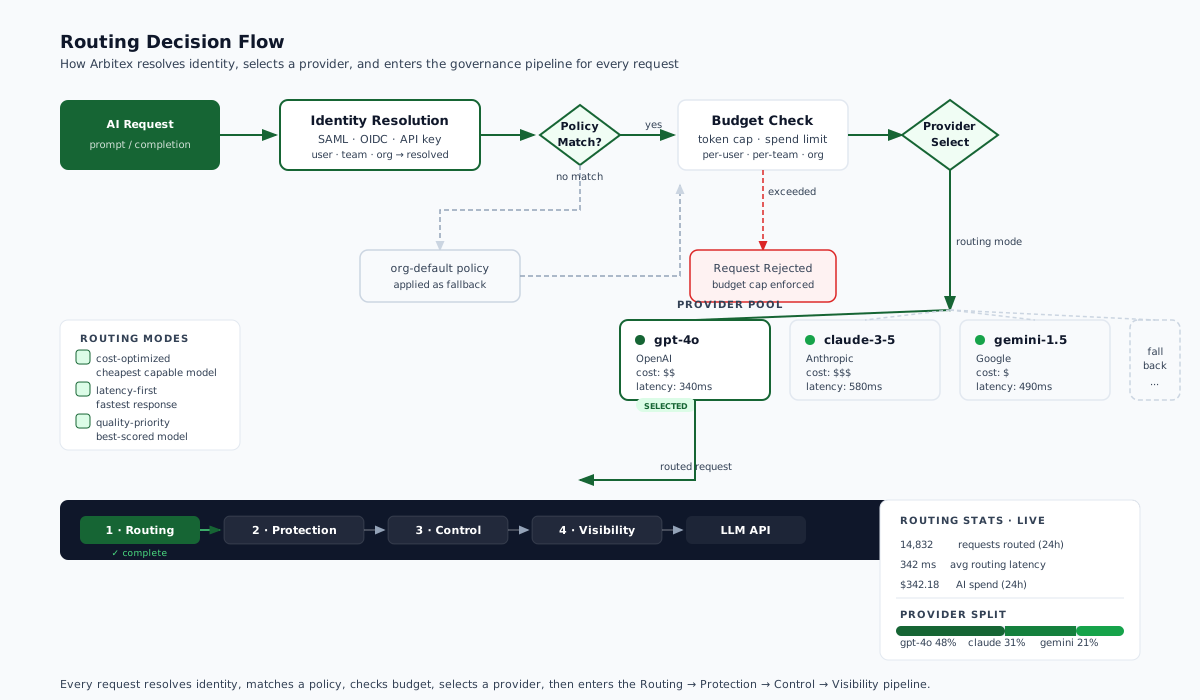
Giving security teams a complete audit record
When a regulator or an internal auditor asks what happened to your AI traffic, the answer is immediate and complete. The audit log captures every request, every policy decision, and every compliance framework event that satisfies it. The record is tamper-evident: once written, it cannot be changed.
Learn more →Building a unified content inspection engine
Every channel — AI gateway, email relay, file uploads, and cloud storage passthrough — needs to extract content from files and scan it for sensitive data. Instead of duplicating that logic per product, the platform uses a shared inspection engine. It handles text extraction from documents, GPU-accelerated OCR for images and scanned PDFs, and runs the full DLP pipeline — all in a single in-process call with no extra network hops. Adding a new file format means adding one handler. Every channel benefits immediately.
Learn more →Making policies easier to write and test before deploying
A governance policy is only useful if it does what you intended. The policy engine lets security teams write policies in plain conditions and test those policies against real traffic before they go live. You can see exactly what a rule would do — and adjust before anything breaks.
Learn more →Deploying into regulated environments
Some organizations cannot send AI traffic through a third-party cloud service. Hybrid Outpost deployment puts the part of the platform that touches your data — inspection and logging — inside your own infrastructure. The management interface and dashboards remain hosted services. Your AI traffic never leaves your network.
Learn more →Knowing which app is sending traffic, not just who
Enterprises run dozens of internal apps and integrations that call AI services. Customer App Registry lets teams register each application as a named client identity — with its own API key, per-client DLP policy, rate limits, audit trail, and usage dashboard. Developers get a self-service portal with a sandbox environment to test configurations before they reach production. The platform stops treating all traffic as anonymous and starts answering the question that actually matters: which app sent this?
Learn more →Recent Deliverables
Email DLP channel
DLP inspection now extends to email. Messages routed through the SMTP relay pass through the same multi-layer content inspection pipeline that protects API and chat traffic, with block and redaction actions enforced end-to-end.
DLP Rules admin console
A visual admin console for DLP policy — apply compliance policy packs and reorder the rule chain with drag-and-drop. See exactly which rules run, and in what order, before anything goes live.
Modality governance
Organizations control which content modalities are allowed. Text and tool-use are enabled by default; image, audio, and realtime modalities are admin-enabled per modality and enforced at the API.
Bring-your-own provider credentials
Customers register their own AI-provider API keys. Credentials are stored with envelope encryption and work identically in the hosted service and in air-gap Outpost deployments.
Outpost detection parity
Air-gap Outpost deployments deliver the same GPU-accelerated detection quality as the hosted service, with signed, verifiable update channels — automatic, notify, or fully offline.
Admin control-plane configuration
End-to-end admin configuration for security and DLP, system settings, monitoring and users, models and routing, and budget controls — all wired into the control plane.
Policy Simulator
Test policy and DLP rules against simulated user groups before deploying. See exactly what a rule would do — and adjust before it touches live traffic.
Coordinated vulnerability disclosure program
Public disclosure policy with safe-harbor, PGP-encrypted reporting channel, RFC 9116 security.txt, acknowledgments page, and documented response SLAs — ready to receive reports from external researchers.
Emergency response and quarantine management
Unified quarantine inbox across all channels — AI gateway, email, and file uploads. Admins can release, reject, or re-scan flagged content from a single dashboard.
Authentication hardening
RS256 JWT signing with JWKS key rotation, Redis-backed session management, and MFA enforcement for admin accounts.
Account recovery — self-service
Secure account recovery flows with identity verification, plus passkey enforcement so recovered accounts keep phishing-resistant authentication.
Container security standardization
Multi-stage Docker builds with non-root execution, read-only root filesystems, dropped Linux capabilities, and no secrets baked into images.
High-performance DLP core
Performance-critical pattern matching, checksum validation, and overlap resolution run as a compiled native extension — same API, same tests, significantly faster on the hot path.
OpenTelemetry observability
Traces and metrics exported to Grafana via the OpenTelemetry Collector. Every request carries a trace ID from ingress through DLP inspection to provider response.
End-to-end test coverage
Thousands of tests across the platform — unit, integration, and end-to-end — covering DLP detection accuracy, policy enforcement, audit chain integrity, and provider routing.
File Inspector channel
Content-addressed file scanning for cloud storage passthrough paths, with format-aware text extraction and quarantine integration across the same 3-tier DLP pipeline.
Client identity and App Registry
Named application identities with per-client API keys, DLP policies, rate limits, and usage dashboards — so security teams know which app sent each request.
Want to see the platform in action?Book a demoand we'll walk you through what the platform delivers.